Presión o tensión arterial:
La presión arterial es la fuerza que ejerce la sangre al circulate through the arteries, while blood pressure is the way arteries respond to this pressure, which achieved thanks to the elasticity of their walls. While both terms are often used interchangeably, is preferable to use blood pressure. In fact, the measure is described in units of pressure (eg, mm Hg). The relationship between the two can be expressed by the law of Laplace: P = T / r where P is pressure, T the tension, and r the radius of a blood vessel.
What is high blood pressure? We
blood pressure that measures the 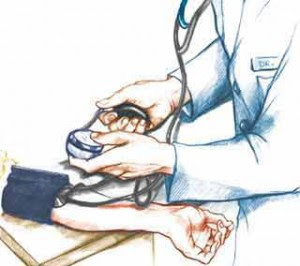 force exerted by blood against the walls of blood vessels as well, excess fluid in the body increases the amount of fluid in the blood vessels and makes blood pressure increase . The blood vessels narrow, hard or obstructed blood pressure also increases.
 force exerted by blood against the walls of blood vessels as well, excess fluid in the body increases the amount of fluid in the blood vessels and makes blood pressure increase . The blood vessels narrow, hard or obstructed blood pressure also increases.
 People with high blood pressure should consult a doctor regularly.
Hypertension can be the result of excess fluid in normal blood vessels or the normal amount of fluid in blood vessels narrow, hard or restricted.
High blood pressure is a major cause of kidney failure, also called end-stage renal disease (ESRD English).
What are the signs and symptoms of high blood pressure?
Most people with high blood pressure has no symptoms. The only way to know if a person's blood pressure is high is to have a health professional measure it with a tensiometer. The result is expressed as two numbers. The first number represents the pressure when the heart is beating, called systolic pressure. The second number represents the pressure when the heart rests between beats, called diastolic pressure. Blood pressure of a person is considered normal if it remains in 120/80 or less, which is usually expressed commonly as "120 over 80." If a person has a systolic blood pressure between 120 and 139 or diastolic blood pressure between 80 and 89, it is considered that the person has prehypertension and therefore should adopt changes in lifestyle to lower your blood pressure and prevent heart disease and blood vessels. If a person has a systolic blood pressure regularly be 140 or older, or whose pressure diastolic is 90 or greater, it considers that the person has high blood pressure should talk to a doctor about the best ways to lower it.
Measuring blood pressure:
For the correct measurement of blood pressure should take into account variables such as
Environment:
- Being in a room quiet.
- Avoid noise and alarm conditions.
- The ambient temperature should be around 20 degrees.
The patient, will:
- not eat plenty, do not smoke, drink alcohol or coffee, or exercise, at least half an hour before the visit.
- not take sympathomimetic agents, including mydriatics.
- not have the full urinary bladder.
- not taking antihypertensive medication in the morning, to make the decision of the PA in the period "valley" of the drug and not fully under the same pharmacological action.
The patient's posture:
- Place
- naked arm to compress.
-
 Sit comfortably (recommended position for shooting purposes) or lying down, putting his arm where it is to measure BP and supported at heart level.
 - Wait 5 minutes in this position.
- To rule out postural or orthostatic hypotension, BP should be measured at one minute and 5 minutes after standing. Is confirmed if there is a decrease in SBP> 20 mmHg and / or DBP> 10 mmHg.
- in pregnant women after 20 weeks, is recommended to measure the PA with the patient in left lateral decubitus or sitting position.

MEASURING INSTRUMENTS OF NOTE:
The measuring apparatus is advisable mercurio.Pueden sphygmomanometer used 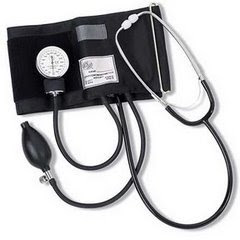
also recently calibrated aneroid sphygmomanometers or validated electronic devices. The sleeve has to be consistent with age and weight of the patient as a small cuff overestimates BP cuff too large and the undervalued. In case of doubt it is preferable to use a sleeve as large as possible.

also recently calibrated aneroid sphygmomanometers or validated electronic devices. The sleeve has to be consistent with age and weight of the patient as a small cuff overestimates BP cuff too large and the undervalued. In case of doubt it is preferable to use a sleeve as large as possible.
TECHNIQUE:
- The apparatus (in the case of columns of mercury) should be at the height of the observer's eyes. Place
- freeing the sleeve antecubital fossa.
- Palpate the brachial artery and gently place the stethoscope around 2 cm. below the cuff.
- The understanding systolic (SBP) was estimated by palpation of the radial artery and the cuff is inflated rapidly to 20-30 mmHg above the level at which the pulse wave disappears.
- The flat should be at a uniform rate of about 2 mmHg per second or heartbeat. Using the first sound is followed by two identical (Korotkoff phase I) to define the SBP and the disappearance of sound (phase V) to define diastolic blood pressure (DBP).
- To record the Korotkoff phase IV (attenuation of noise) in hyperkinetic states, fever, pregnancy or in children.
- opening shot in the BP should be measured in both arms, and if there is a pressure difference greater than 10 mmHg should evaluate possible causes and consider the individual pressures far higher. In subsequent visits the PA will be determined solely on the arm with higher figures (control arm).
- At each visit must be at least two shots of the PA separated by 2 minutes and average values. If the first two readings differ by more than 5 mm Hg should additional footage made until the difference is equal to or less than this figure. Consider how the visit PA average of the last two shots.
- If an arrhythmia is recommended to measure the PA five times and averaged.
- is advisable to register immediately and TA figures show no preference for certain numbers.


